


Why Photochromic Lenses Get Darker in the Winter (and What Really Affects Their Performance)
- AccuLab Optical

- Jan 27
- 5 min read
By Jon J. Trutt
Published: 1/27/2026

If you’ve ever worn or dispensed photochromic lenses (commonly known by brand names like Transitions®), you may have noticed something interesting: they often get darker in the winter than they do in the middle of summer, even when it doesn’t feel that bright outside.
So what’s really going on? Is it the snow? The cold? The sun angle? Short answer: yes… all of the above. Let’s break it down.
________________________________________
The Biggest Factor: Temperature 🥶
Photochromic lenses work thanks to special molecules embedded in the lens material. When those molecules are exposed to UV light, they change structure and darken.
Here’s where temperature comes in:
Cold temperatures slow the molecules down, allowing them to stay in their darkened state longer
This lets the lenses reach a deeper, darker tint
In warmer temperatures, the molecules move faster, so the lenses don’t get quite as dark and fade back more quickly
That’s why photochromic lenses can look impressively dark on a cold winter day, but seem lighter on a hot summer afternoon.
________________________________________
The Snow Factor: UV Reflection ☀️❄️
Snow doesn’t just look bright; it’s a powerful UV reflector.
Fresh snow can reflect up to 80% of UV light
That UV hits the lenses from below and the sides, not just straight ahead
More UV exposure = more activation of the photochromic molecules
So even if the sun feels weak, snow can dramatically increase how dark your lenses get.
________________________________________
UV Intensity vs. Visible Brightness 🕶️
One of the most common misconceptions is that photochromic lenses react to brightness. They don’t.
They react to UV light, which means:
Overcast days can still trigger strong darkening
Winter sun can produce plenty of UV despite feeling less intense
Bright-looking conditions don’t always equal high UV, and vice versa
This is why lenses can darken more than expected on a cloudy winter day.
________________________________________
Mirrors and Winter Benefits ✨
Mirror coatings can provide extra advantages in winter conditions. Reflective mirrors help reduce glare from snow, ice, and wet surfaces while enhancing contrast and comfort. When paired with photochromic lenses, mirrors can maximize both performance and style, especially on bright, reflective winter days.
Specialty photochromic lenses like XTRActive® and Younger Optics DriveWear® benefit even more from mirror coatings. XTRActive lenses gain extra glare reduction outdoors, while DriveWear lenses combine visible-light activation, polarization, and mirrors for optimal clarity and comfort during winter driving.
Mirror coatings can provide extra advantages in winter conditions. Reflective mirrors help reduce glare from snow, ice, and wet surfaces while enhancing contrast and comfort. When paired with photochromic lenses, mirrors can maximize both performance and style, especially on bright, reflective winter days.
________________________________________
Choosing the Right Photochromic Option 🤔
Not all photochromic lenses are designed to behave the same way, and understanding the differences helps ensure patients get the performance they expect.
Standard photochromic lenses rely primarily on UV light to activate. They are fully clear indoors and work well outdoors, but activate minimally behind a windshield due to UV-blocking glass. (Examples include Transitions® Gen S™ and AccuLab LightSwitch™ photochromics.)
XTRActive® photochromic lenses are designed to activate using both UV and some visible light, allowing them to darken more consistently in bright conditions and offer partial activation while driving. They're clear indoors with a hint of protective tint and extra dark outdoors. They also come in a Polarized option.
Younger Optics DriveWear® lenses are purpose-built for driving. They activate strongly behind the windshield using visible light and include built-in polarization to reduce glare from roads, dashboards, and windshields.
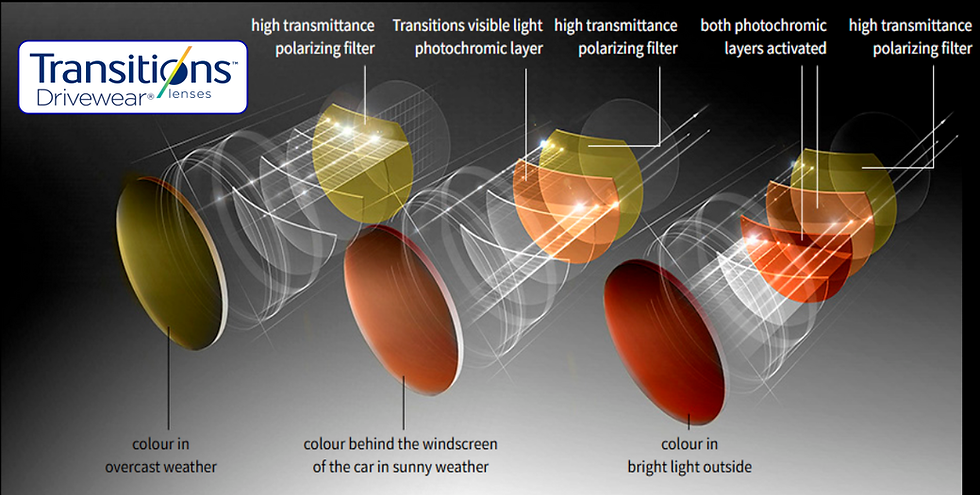
Selecting the right option depends on how and where the lenses will be used, especially for patients who spend significant time behind the wheel.
Want help choosing the right option? Talk to AccuLab about standard photochromic, XTRActive, and DriveWear lens options to find the best fit for your patients’ needs.
________________________________________
Other Factors That Play a Role
Several additional variables can influence how photochromic lenses behave:
🌄 Altitude
Higher elevation = more UV exposure
Roughly 10–12% more UV per 3,000 feet
Ski trips are the perfect storm: cold + altitude + snow
👓 Lens Material
Polycarbonate, Trivex, and high-index materials all activate slightly differently
Some materials activate faster, while others reach a deeper final tint
📏 Prescription & Thickness
Thicker lenses contain more photochromic material
Higher prescriptions may appear darker, especially at the edges
🎨 Lens Color
Gray, brown, graphite green, and specialty colors can appear darker even if activation is similar
🧊 Wind & Surface Temperature
Cold wind can cool the lens surface quickly
This can push lenses into a darker state faster than expected
🚗 Inside the Car
Standard photochromic lenses won’t darken much behind a windshield because UV is blocked
XTRActive lenses can provide some activation due to visible-light sensitivity
DriveWear lenses are specifically engineered for driving, activating behind the windshield and reducing glare through polarization
Standard photochromic lenses won’t darken much behind a windshield because UV is blocked
Specialty versions designed to respond to visible light can activate while driving
________________________________________
Customization Without Compromise ✅
For patients who want a more personalized look, tinting polarized lenses can be a great way to customize color and style without sacrificing performance, as long as it’s kept light and intentional. Subtle tints can enhance comfort and aesthetics while preserving polarization efficiency and visual clarity.
________________________________________
Why This Matters for Wearers 🤓
Understanding how photochromic lenses behave helps set realistic expectations:
Winter performance is often stronger and darker
Summer performance may feel lighter, but faster to fade
Neither is a defect; it’s simply how the technology works
At AccuLab, we make it a priority to educate eye care professionals and wearers so there are no surprises, just better visual comfort in every season.
________________________________________
Quick FAQ: Photochromic Lenses ❓
Do photochromic lenses get darker in the winter?
Yes. Cold temperatures allow the photochromic molecules to stay dark longer, and winter conditions often include higher UV reflection from snow.
Are photochromic lenses reacting to brightness?
No. They react to UV light, not visible brightness.
Why do they seem lighter in summer?
Heat causes the molecules to revert back faster, limiting how dark the lenses can get.
Will photochromic lenses work in the car?
Standard photochromic lenses activate minimally behind a windshield because most windshields block UV light.
However, specialty lenses designed for driving perform much better. Younger Optics DriveWear® lenses are engineered to activate using visible light as well as UV, allowing them to darken behind the windshield. They also feature built in polarization to reduce glare from dashboards, windshields, and the road, making them an excellent option for patients who spend a lot of time driving.
________________________________________
Why This Matters for Eye Care Professionals 🧐
Educating patients about how photochromic lenses behave helps prevent confusion, remakes, and dissatisfaction, especially during seasonal changes. When expectations are set correctly, photochromic lenses remain one of the most versatile and comfortable lens options available.
If you have questions about materials, designs, or which photochromic option makes the most sense for your practice, the AccuLab team is always here to help.
________________________________________
Have Questions About Photochromic Lenses? 📞📩🤝
If you’d like help choosing the right photochromic option for your patients, or want to understand how different materials and designs perform, we’re always happy to help.
Reach out to the AccuLab team anytime. We’ve got you covered, rain, snow, or sunshine. 😎 800-688-3904 or info@acculab.net


Comments